
Want to have impact? How you tell your story matters!
By Katherine RussellAbout five months after a double lung transplant, I was invited to speak in front of a group of college students to encourage them to pledge as organ donors. My transplant had been urgent, unexpected, and physically strenuous, and like many survivors, I felt I’d borne witness to something spiritually ineffable and life-altering. Quite naturally, I was reaching for a deeper meaning and purpose.
Sharing my story was a start.
Having done a lot of public speaking in my youth, I figured talking to a group of students about my latest medical event seemed, on the surface, like any other gig. To the best of my ability, with all 85 pounds of me quaking at the front of the room, I detailed the brutal months leading up to and recovering from my surgery. I choked through my words. I felt suddenly overwhelmed and incapable of making them feel what I felt.
I’d been certain that by my mere survival this group would be irrevocably moved and ready to act. Instead, what I got were questions. What did my experience have to do with them? I received generous and encouraging comments, but I also encountered pushback about the organ donation process – in the end, many still had their doubts of whether they wanted to take the pledge. It was not the ovation I expected. When I got back to my car, feeling raw and uncertain of myself, I bawled over the steering wheel.
I was accustomed to treating the physical things – my lungs, the tender scars on my chest, my endless pursuit of calories – but the internal wounds were untended. I had not yet processed the trauma I’d been through nor the guilt I felt for struggling with my reality.
This storytelling experience taught me many lessons. One, I realized in that moment how much healing I needed before I could share my story. This is why I have committed my consulting career to helping people prepare for sharing their personal stories in public spaces, with legislators, and in media. It is also why I have tailored a specific training for people living with cystic fibrosis called Spit It Out, which I offer virtually multiple times throughout the year.
My training always begins with opening people up to mining their own experiences more deeply. After all, we cannot properly tell our stories without first understanding them ourselves.
Second, we cannot control how people will receive our stories. However, when it comes to public speaking, we can control the following:
- The way you tell it. There are a million different ways to tell your story, and how you tell it matters. You can employ literary and elocutionary tactics to ensure you’re compelling, relatable, and that your meaning is clear to your audience.
- The practice you put in. Rehearsing will impact your delivery in every way. Practice helps you recognize where you get stuck and will help you present smoothly and with confidence. Even the most seasoned public speakers practice their delivery beforehand.
- The supports you build around you. Be sure you’re bringing along your support system – the people who believe in you, pump you up, and pick you up – even if they are just waiting by the phone to check in with you afterward.
- The boundaries you create. Only share what you are ready to. If you share too much or before you’ve done real healing work, it can be psychologically and emotionally taxing. You owe your audience the truth, but with boundaries – which means you get to choose which details to share in a way that will not retraumatize or trigger you.
- The person with the microphone. Public speaking is only a portion of the real work behind moving or influencing others; it is just a moment in time where we share a nugget of insight. Behind that moment, we also need to connect with other people’s stories and pour into the world to reach a position of humility and credibility. You can transcend any uncomfortable moment on a stage if you are building the best version of yourself, and that is a version you can stand by.
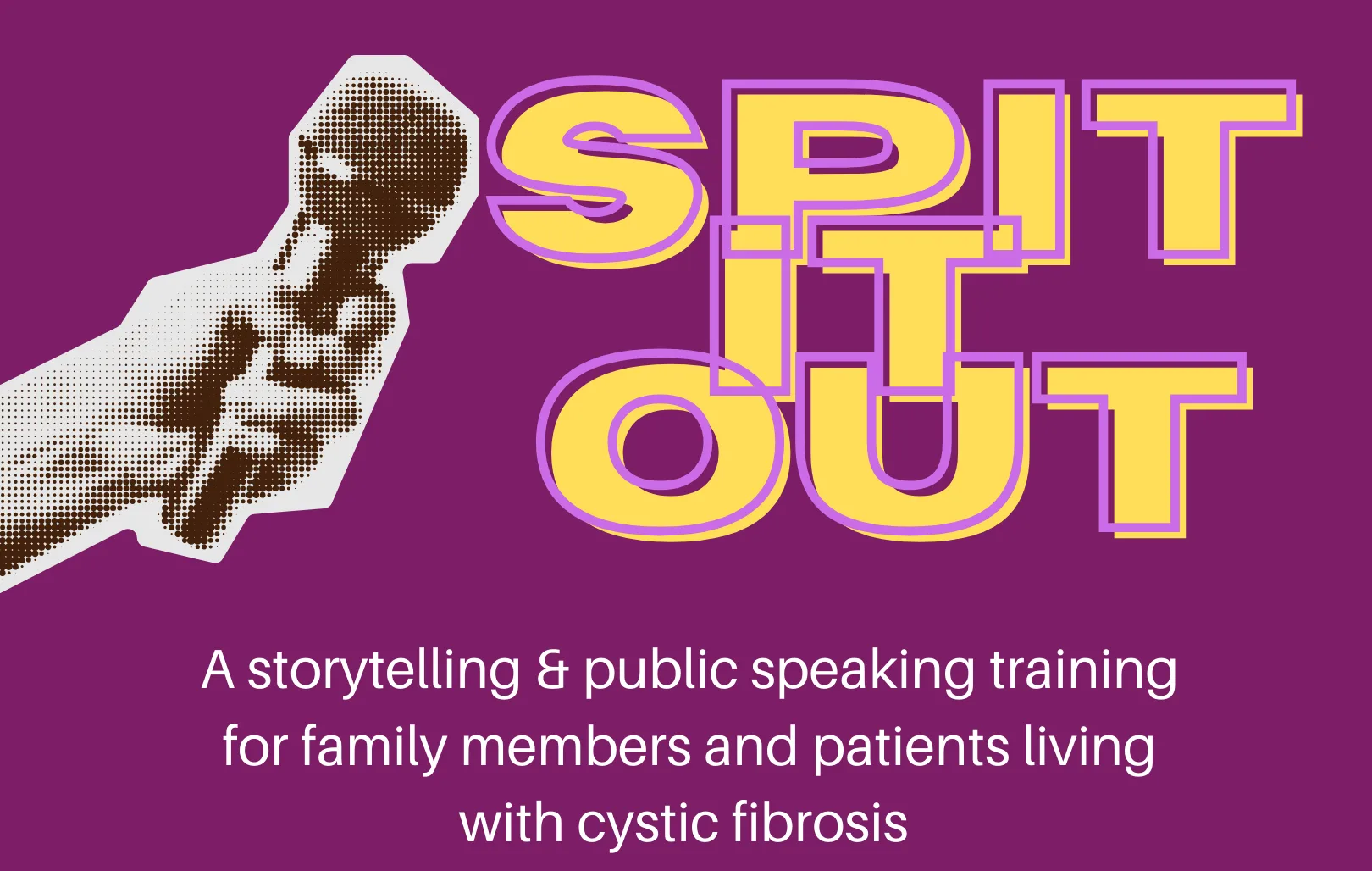
Join a Spit it Out Session
Winter 1-day
February 7, 1pm – 4pm ET (12pm CT / 11am MT / 10am PT)
The Winter 1-day is geared toward people who already have a speech drafted and want feedback. This is a masterclass-style workshop that will allow you to present your story (must be less than 10 minutes long) and receive feedback to strengthen delivery, form, and content.
3-Part Intensive
April 4 (Saturday, 1pm – 4pm ET)
April 8 (Wednesday, 6pm – 8pm ET)
April 11 (Saturday, 1pm – 4pm ET)
The 3-part series is designed for people who are not sure what story they want to tell or how. By the end of this workshop, you will have drafted and received feedback for a 5-7 minute “base” speech that you can pitch for speaking opportunities. This particular series focuses on self-exploration, understanding your CF journey, how to relate your personal story to a broader cause, and learning the fundamentals of strong storytelling and speechwriting.
If you want to learn more about storytelling and public speaking specifically for people with CF, join a Spit It Out training. You can learn more by visiting www.katherinekeepswriting.com/speakertraining
Katherine Russell is a writer and activist in Washington, D.C. She is a producer of Bold Enough to Ask, a BreatheStrong podcast on CF sexual and reproductive health, and she is the author of With Every Breath: Stories by and about people living with cystic fibrosis (2006) and Shapes of Water: coming of age with cystic fibrosis (2012). She is a member of the Cystic Fibrosis Foundation’s Success with Therapies Research Consortium steering committee. Katherine is also the founder and CEO of Transformative Justice Solutions, a social justice consulting firm that assists organizations in elevating the voices of people with lived experiences to effect change.